National Astronomical Observatory
Scientific infrastructure over 200 years old

Stellar evolution
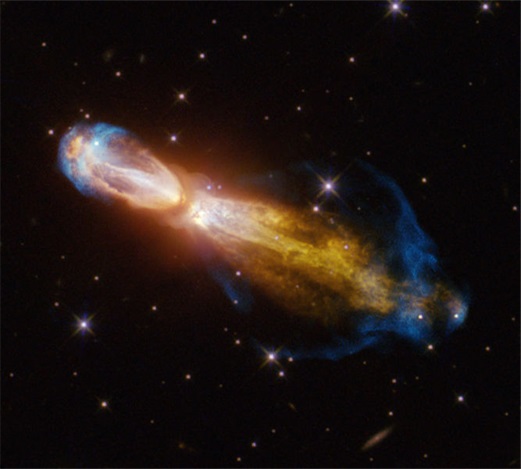
Most stars die after ejecting almost all their mass, becoming spectacular and wide nebulae; our Sun will also do so. OAN astronomers are actively studying these last phases of the stellar evolution.
When a normal star gets old, it undergoes a great expansion, its radius becomes so big that the star would engulf any planet rotating in the same orbit as the Earth. These stars, which are now relatively cool, are named red giants. The evolution beyond this phase is precisely the most spectacular in the life of the majority of stars. Red giants lose mass copiously, and this process tends to increase with time. When the star has ejected most of its mass, the compact central core becomes visible. In only 1000 or 2000 years, the star evolves from a red giant, cool and very large, into a blue or white dwarf, extremely compact and hot.
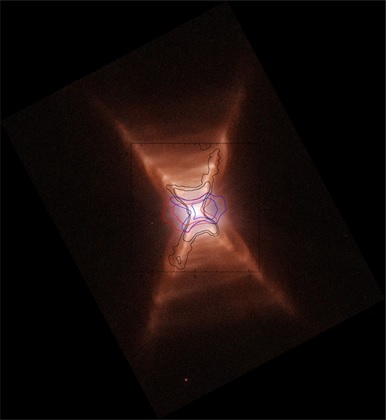
These dwarf stars are still surrounded by the previously ejected material that, now illuminated and excited by the residual star, is called planetary nebula (for historical reasons, though they have nothing to do with planets). Planetary nebulae themselves are in vertiginous evolution, with an important dynamical interaction between the different phases of the stellar winds, that finally shape the beautiful images often shown by them. In this way, old stars become extended nebulae.
Specifically, we highlight our studies on:
- The structure of envelopes around red giants and the chemical abundances in them, both in general and for outstanding objects.
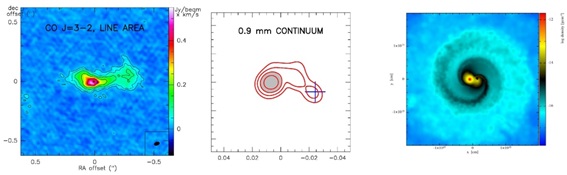
- The structure and chemistry of planetary nebulae. Particularly relevant is our work on the coldest components, that usually contain most of the nebular mass.
- The structure and dynamics of very young planetary nebulae. Let us mention our studies of the wind interaction, the associated shock waves, and the effects of stellar binarity in this phase.