Astronomical information


Draconids
Draconid meteor shower is visible in the northern hemisphere between October 6 and 10, and its peak is around October 8.
The Draconids are usually a modest meteor shower, generating about 20 meteors per hour, with a speed of 20 kilometers per second. But during the years 1933 and 1946 some impressive displays were visible, with a rate of thousands of meteors per hour. Also in October 2011, despite the fact that the Moon made the observation difficult, more than 600 meteors per hour were detected.
What to expect in 2026?
The maximum of this shower will be on October 9 at around 2 a.m. universal time. Although this is not a strong shower, some years it may present peaks of activity due to our planet crossing dense filaments of the cometary tube. This is not expected for this year. The Moon will be nearly new and it will rise just before the Sun, therefore it is a good year for the observation of this shower.
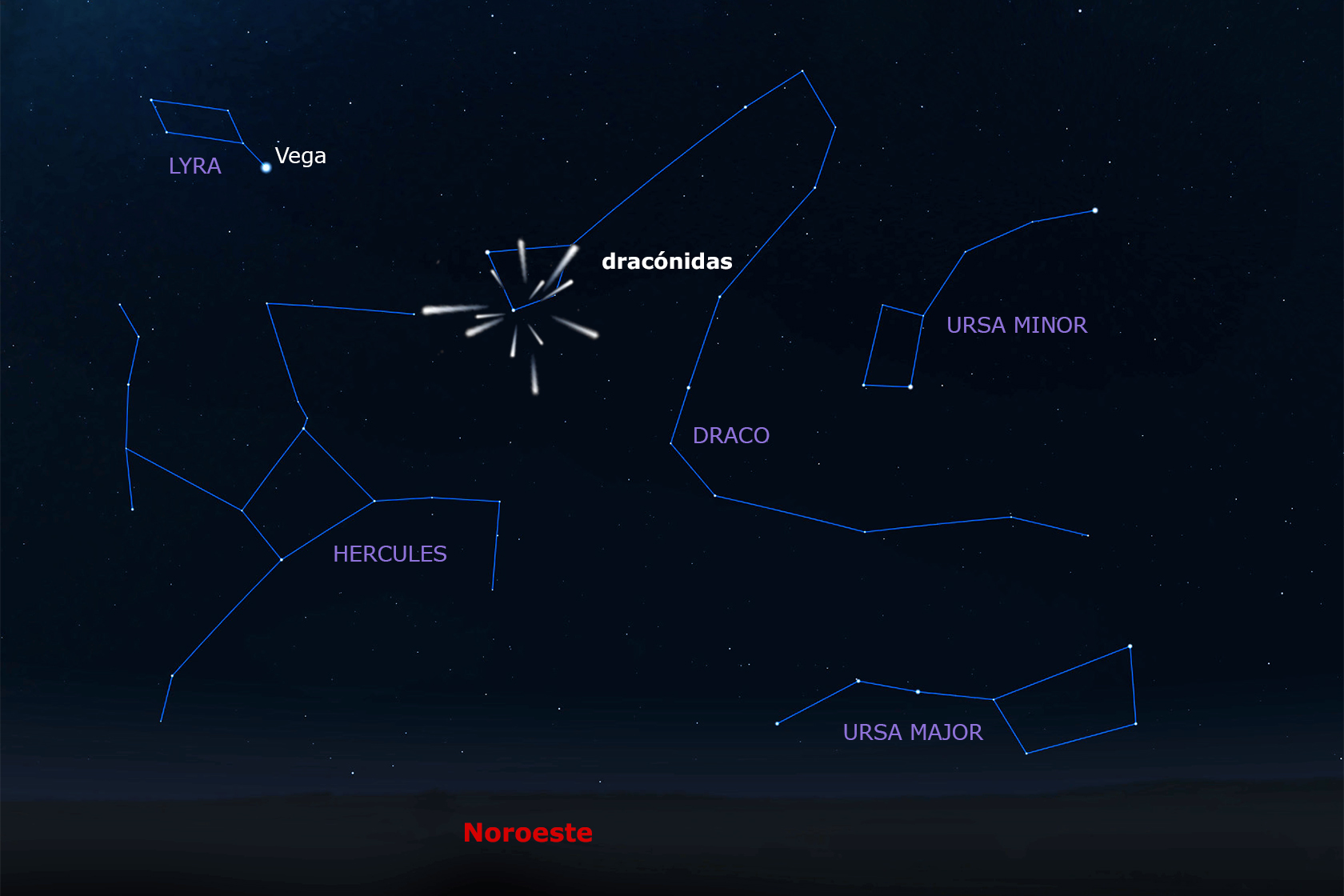
The 'radiant' of the Draconids.
Why do they happen?
The Draconids occur when the Earth passes through a ring formed by the fragments detached from comet 21P/Giacobini-Zinner, which is why this meteor shower is also known as the Giacobinids. When one of these fragments (or meteoroids) comes into contact with the Earth's atmosphere, it is burnt by friction with the air, thus creating the luminous glow that we know as a meteor or shooting star.
Shooting stars seem to originate from a point in the sky known as the radiant and its location is usually used to name the meteor shower. The radiant of the Draconids is found in the constellation of Draco or the Dragon.
How to see the Draconids?
They can be observed from any location as long as it provides a dark sky. It is preferable to observe from a place that has few obstacles that limit our sight (such as buildings, trees or mountains), and not to use optical instruments that reduce our field of vision. Even though the Draconids seem to come from the constellation of Draco, they can be seen anywhere in the sky. It is advisable to look at the darkest areas, in the opposite direction to the position of the Moon if the observation is made before it sets. The most comfortable strategy is to lie down and wait for your eyes to get used to the darkness.