Astronomical information


Summer
The start of summer
The summer of 2026 in the northern hemisphere will begin on June 21 at 09:24 hours Spanish mainland time according to calculations by the National Astronomical Observatory (National Geographic Institute - Ministry of Transport and Sustainable Mobility). This season will last approximately 93 days and 16 hours, and will end on September 23 with the beginning of autumn.
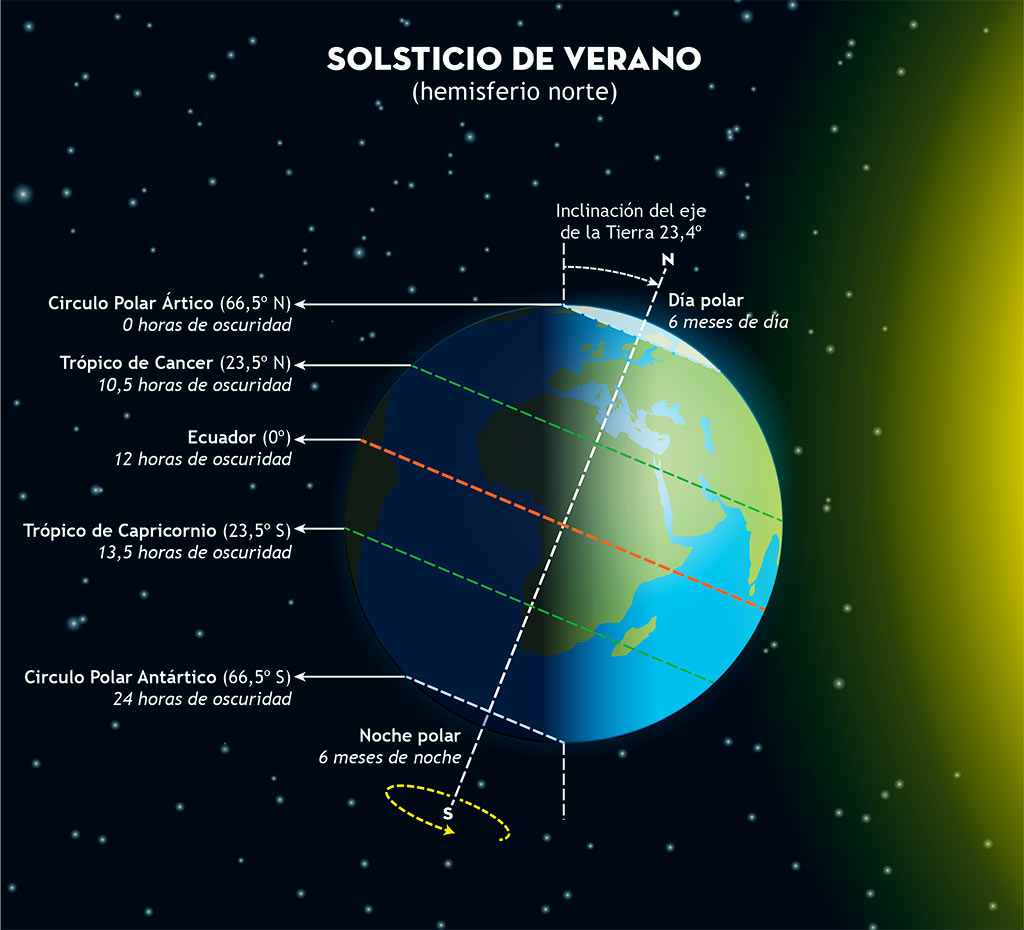
The beginning of summer in the northern hemisphere is defined by the moment when the Earth passes through the point in its orbit from which the Sun has its maximum northern declination. On the day when this happens, the Sun reaches its highest elevation above the horizon at noon and describes the longest arc in the sky. As a result, this is the day with the most hours of sunlight of the year. In addition, for several days the maximum height of the Sun at noon does not seem to change, and because of this, the beginning of summer is also called the summer solstice (from the Latin solstitium, still Sun).
The beginning of summer in the northern hemisphere coincides with the beginning of winter in the southern hemisphere.
The sky during summer 2026
Summer nights, although short, are usually the warmest of the year, and therefore represent a good opportunity to explore the sky. In addition, in summer it is common to travel to places such as the countryside and the beach, where dark skies allow us to see the sky better.
The sky after sunset in early summer will have Mercury,Venusand Jupiter, which will be visible until late July. The first one will be visible until late June, and will reappear in early September. Jupiter will be in the sky until mid July.
In the sky before sunrise, we will be able to see Mars and Saturn. Jupiter will be visible from mid August, and Mercury from late July to late August.
In addition to the planets, it is easy to distinguish groups of bright stars in the sky. The most characteristic of summer is the triangle formed by Altair, in the constellation of the Eagle, Deneb, in the constellation of the Swan and Vega, in the constellation of the Lyre. This is the so-called summer triangle, and is technically speaking an asterism, as it combines stars from different constellations. To the south, typical of summer are the constellations Scorpius, with the bright reddish star Antares, and Sagittarius, whose position roughly indicates the centre of the Milky Way. This white band, representing the combined brightness of the millions of stars that make up our galaxy, can be seen in summer in all its splendour across the sky from south to north, although a dark sky is necessary to distinguish it well.
Other phenomena of astronomical interest during the summer of 2026 will be the Delta Aquarid meteor showers, expected to peak around 31 July, and the popular Perseids, expected to peak around 13 August. The full moons of the season will occur on June 29, July 29, and August 28.
On 6 July there will be the moment of maximum annual distance between the Earth and the Sun, known as aphelion. When that happens, our distance from the Sun will be just over 152 million km, which is about 5 million km more than at the time of the smallest distance (perihelion), which happened on January 3.
During summer, 2026, two eclipses will take place: a total solar eclipse in August 12, and a partial Luna eclipse in August 28. The totality phase of the first will be visible from the Arctic, Greenland, Iceland, and from Spain just before the sunset. The second, with a large magnitude, will be visible from America, Europe, and Africa. The Moon will set before the end of the eclipse in Spain.
Some interesting facts about summer
With just over 93 days, summer in the northern hemisphere is the longest season of the year. This is because the Earth's orbit around the Sun is not circular but elliptical and summer coincides with the time of year when the Earth is furthest from the Sun. When this happens, the Earth moves more slowly in its orbit (according to what is known as Kepler's second law), and therefore needs more time to reach the point where the next season begins, which is autumn.
The beginning of summer can occur on at most three different dates in the calendar (20-22 June). Throughout the 21st century, summer will begin on 20 and 21 June (the official Spanish date), with the earliest beginning in 2096 and the latest in 2003. The variations from year to year are due to the way the sequence of calendar years (some leap years, some not) fits in with the length of each orbit of the Earth around the Sun.
Although the day of the summer solstice corresponds to the day with the highest number of hours of sunlight, the difference in hours between day and night depends on the latitude of the place. For the latitude of Madrid, the day of the summer solstice will have 15 hours and 3 minutes of sunlight, compared to 9 hours and 17 minutes of sunlight on the shortest day (winter solstice). The difference between the longest and shortest day is therefore almost six hours. As we get closer to the equator, this difference decreases, while at the Earth's poles the difference is at its maximum.
For more information on the astronomical phenomena of the year, please consult the Almanak of the Astronomical Observatory, published by the National Geographic Institute.
Information provided by the National Astronomical Observatory (IGN, Ministry of Transport, and Sustainable Mobility). Reproduction in whole or in part is authorised provided the source is acknowledged.