Astronomical information


Winter
The beginning of winter
The winter of 2025-2026 in the northern hemisphere will begin on December 21, 2025 at 16:03 hours official Spanish mainland time according to calculations by the National Astronomical Observatory (National Geographic Institute - Ministry of Transport, Mobility and Urban Agenda). This season will last approximately 88 days and 23 hours, and will end on March 20, 2026 with the beginning of spring.
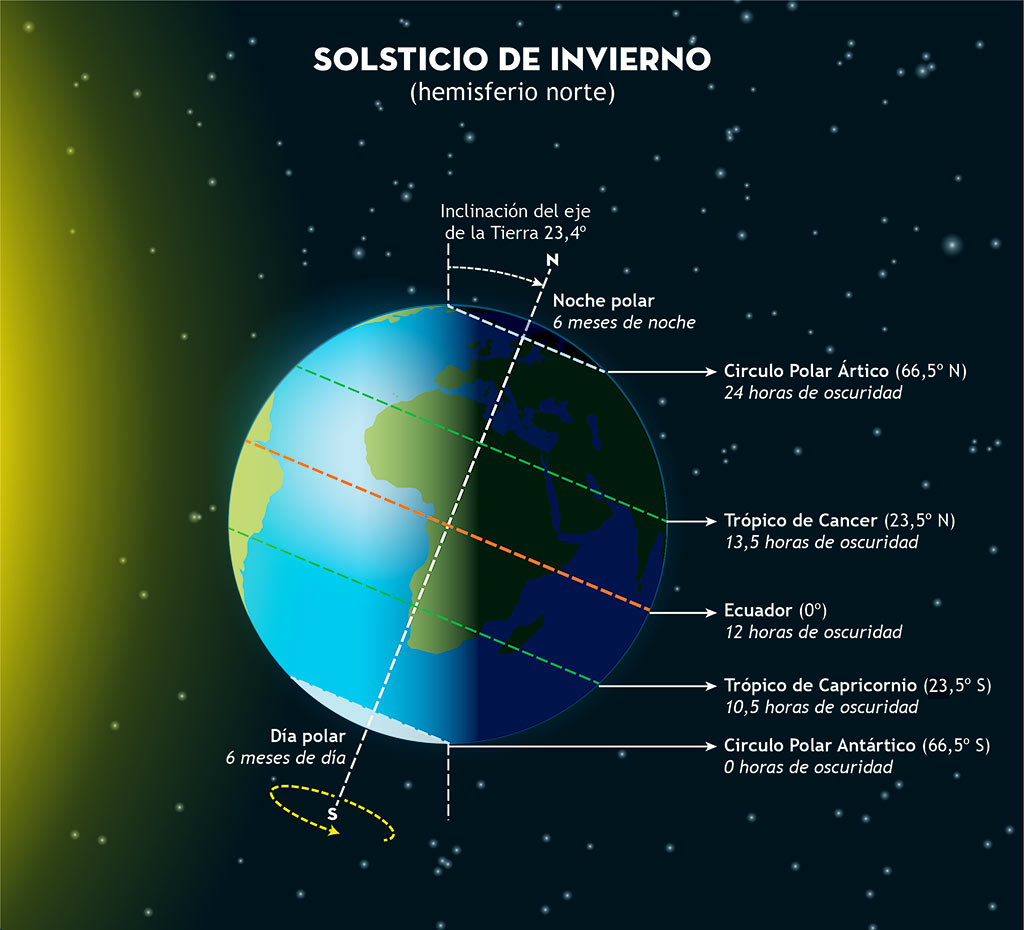
The onset of winter in the northern hemisphere is defined by the moment when the Earth passes through the point in its orbit from which the Sun has its maximum southern declination. On the day when this happens, the Sun reaches its lowest elevation above the horizon at noon and describes the shortest arc in the sky. As a result, this is the day with the fewest hours of sunlight of the year. In addition, for several days the maximum height of the Sun at noon does not seem to change, and because of this, the beginning of winter is also called the winter solstice (from the Latin solstitium, still Sun).
The beginning of winter in the northern hemisphere coincides with the beginning of summer in the southern hemisphere.
The sky during winter 2025-2026
Winter nights are long and often dry, making them excellent for observing the sky. During winter 2025-2026 we will be able to see different planets and constellations throughout each night.
During the winter, we will be able to see Saturn at dusk, joined by and Jupiter from the beginning of January, along with Venus from mid February, but as the months go by, Saturn will move closer to the Sun, disappearing from the evening sky in early Marc. Mercury will make an appearance during February.
The dawn sky in winter, on the other hand, will begin with Jupiter and Mercury visible. This last one will dissapear from the morning sky by the beginning of January, and will reappear in mid March, whereas the giant planet will stop to be visible from mid January.
In addition to the different planets, the winter evening sky will show us some of the constellations that are favourites among amateurs, as they contain the brightest stars. These include Orion, with the bright (and variable) Betelgeuse, Taurus, with the reddish Aldebaran, Can Major with Sirius, the brightest star of the night sky, and Gemini, with the pair Castor and Pollux. Joining some of these stars with other adjacent stars forms an asterism known as the winter hexagon as it is characteristic of the evening sky of the season.
Other phenomena of astronomical interest during the winter of 2025-2026 include the ursids meteor shower, expected to peak around December 22 and the quadrantids, expected to peak around January 3. Winter full moons will occur on January 3, February 1, and March 3.
On January 3, 2026 the moment of maximum annual approach between the Earth and the Sun, called perihelion, will occur. At that time, our distance from the Sun will be just over 147 million km, which is about 5 million km less than at the time of maximum separation (aphelion), which will occur on July 6, 2026.
During the winter of 2025-2026 there will be an annular solar eclipse and a total lunar eclipse. The solar eclipse will take place on February 17, and the annular phase will be visible from Anctartica, the Anctantic Ocean, and the south of the Indian Ocean. The lunar eclipse will occur on March 3, and it will be visible from America, the East of Asia, and Oceania. They will not be visible from Spain.
Some interesting facts about winter
At just under 89 days, winter in the northern hemisphere is the shortest season of the year. This is because the Earth's orbit around the Sun is not circular but elliptical and winter coincides with the time of year when the Earth is closest to the Sun. When this happens, the Earth moves faster in its orbit (according to what is known as Kepler's second law), and therefore needs less time to reach the point where the next season begins, which is spring.
The onset of winter can occur on at most four different dates in the calendar (20-23 December). Throughout the 21st century, winter will begin on 20-22 December (official Spanish date), with the earliest onset in 2096 and the latest in 2003. The variations from year to year are due to the way the sequence of calendar years (some leap years, some not) fits in with the length of each orbit of the Earth around the Sun.
Although the day of the winter solstice corresponds to the day with the least number of hours of sunlight, the difference in hours between day and night depends on the latitude of the location. For the latitude of Madrid, the winter solstice day will have 9 hours and 17 minutes of sunlight, compared to 15 hours and 3 minutes of sunlight on the longest day (summer solstice). The difference between the shortest and the longest day is therefore almost six hours. As we get closer to the equator, this difference decreases, while at the Earth's poles the difference is at its maximum.
the difference is at its maximum. For more information on the astronomical phenomena of the year, please consult the Almanak of the Astronomical Observatory, published by the National Geographic Institute.
Information provided by the National Astronomical Observatory (IGN, Ministry of Transport and Sustainable Mobility). Reproduction in whole or in part is authorised provided the source is acknowledged.